
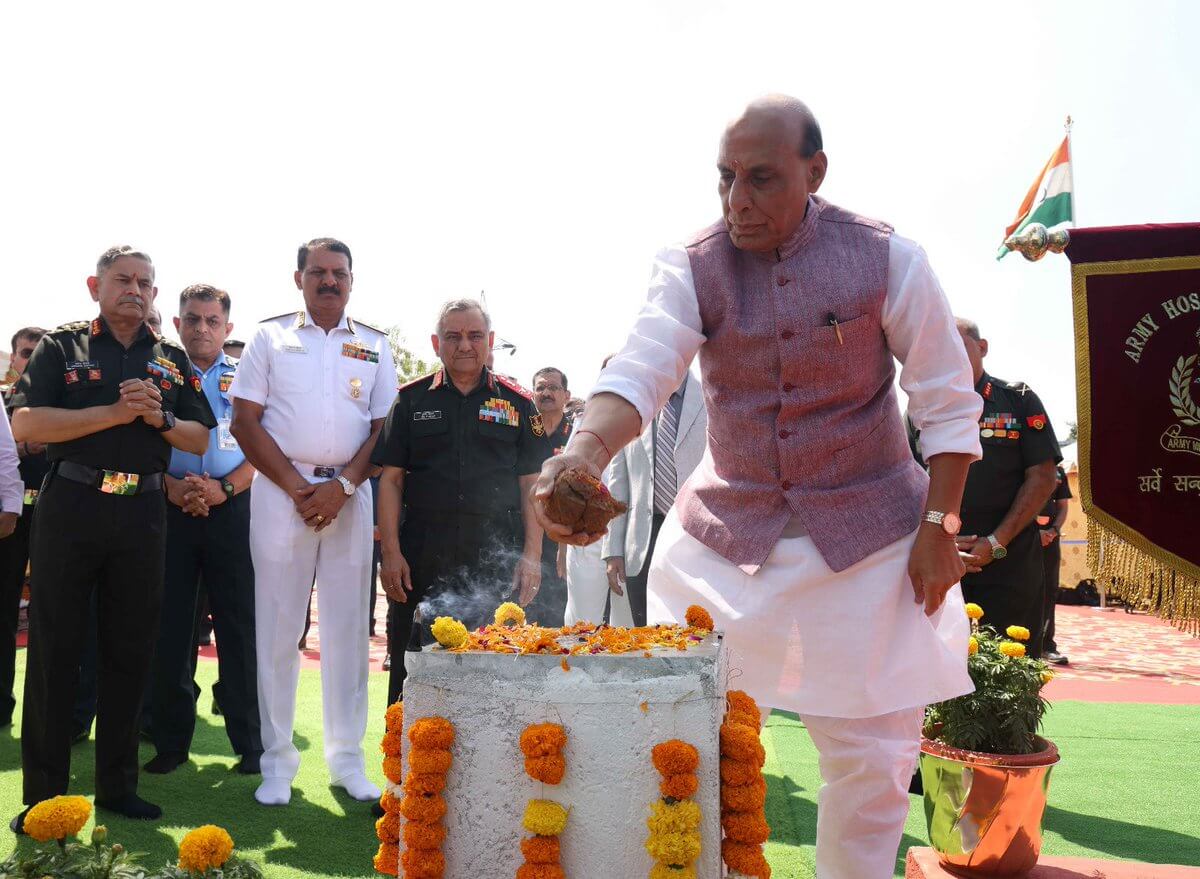
Raksha Mantri Shri Rajnath Singh laid the foundation stones of Ophthalmology, Oncology and Joint Replacement Centres at Army Hospital (Research & Referral) and new infrastructure at Base Hospital, Delhi Cantt as part of the 262nd Army Medical Corps Raising Day celebrations. The state-of-the-art facilities at Army Hospital (Research & Referral) are envisaged to significantly enhance the tertiary care capabilities of the Armed Forces Medical Services (AFMS), particularly in the domains of advanced eye care, cancer treatment, and complex joint replacement surgeries, while the new hospital infrastructure at Base Hospital is being developed with a capacity of 998 beds along with an additional 100 crisis expansion beds, to address routine and emergency healthcare requirements of the Defence Forces personnel.
In his address, Raksha Mantri underlined the importance of continued innovation, capacity building, and integration of modern technologies to meet the emerging challenges in military medicine. He exuded confidence that the new facilities, equipped with modern technologies and infrastructure, will provide quality medical care to the serving personnel, veterans & their dependents.
Drawing attention on the crucial subject of clinical trials, Raksha Mantri said that clinical trials are industry-sponsored in many advanced nations, and equal emphasis is placed on research, treatment & innovation. He pointed out that while efforts in this direction are being made in India, there is a need for reforms within the clinical trial framework. “We must explore how AFMS can make a meaningful contribution in this domain, ensuring that our medical capabilities extend beyond mere curative treatment to encompass the creation of new knowledge,” he said.
Shri Rajnath Singh also pitched for creating robust Standard Operating Procedures and standardised protocols for dissemination of clinical experience regarding a specific disease to other doctors and hospitals through systemic channels. “This would render faster, more efficient, and evidence-based treatment, enhancing not only individual capability but overall system efficiency. Establishing a national-level data pool would be a monumental step in this direction. It would provide better inputs for policy formulation, aid in validating new medical practices, and enable large-scale replication of effective treatments, thereby gradually transforming our healthcare system from a reactive into a proactive model,” he said.
On the heavy workload in hospitals, Raksha Mantri stated that doctors remain constantly occupied with providing treatment & performing surgeries, and crucial aspects such as research, training, and teaching tend to take a backseat. This is a practical challenge that needs to be acknowledged, urging AFMS to explore ways to effectively balance the immense workload.
Shri Rajnath Singh also urged AFMS to examine the feasibility of setting up institutions at par with Army Hospital (R&R) in all four corners of the country with the aim to provide the soldiers at every region and location, superior medical facilities. “It is not strictly necessary to establish a greenfield project or construct an entirely new institution. There are immense possibilities within brownfield projects. Command Hospitals or Base Hospitals at various locations can be upgraded with modern facilities and elevated to this very same standard,” he suggested.
Raksha Mantri emphasised that in today’s context, ‘security’ encompasses far more than merely safeguarding borders, with health security holding equal significance. “Health security plays a pivotal role when we successfully execute major operations like Operation Sindoor. When our soldiers possess the confidence that superior medical support is available to them, they accomplish their missions without apprehension. Therefore, it is imperative to adopt a consistently proactive and positive approach toward health security,” he said.
Shri Rajnath Singh stressed that the parameters of growth of a nation are not solely economic, but encompasses other significant dimensions; the most critical being the health of the people. “The medical sector needs to continuously understand these evolving challenges, address them effectively, and constantly update itself in sync with the changing times. We must move forward with a vision where progress is not confined merely to economic growth but is holistic in nature, where health is recognised as a central pillar of that development,” he said.
Raksha Mantri concluded his address by acknowledging the services rendered by the nurses of the Military Nursing Service, who, he said, serve as the bedrock of the medical forces. He stated that the recent decision to grant them the status of ‘ex-servicemen’ upon retirement underlines the Government’s commitment towards the welfare of the defence forces personnel as well as medical professionals.