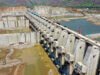


The Polavaram Irrigation Project in Andhra Pradesh has achieved 90.1 per cent overall physical progress, while the financial progress of Phase I reached 78 per cent, marking a significant milestone in the execution of the multipurpose river valley project.
The spillway, main dam in Gap III, diaphragm walls in Gaps I and II, upstream and downstream cofferdams, upstream cofferdam buttress, and Right Main Canal have been fully completed. Civil works have achieved 88 per cent financial progress, while land acquisition stands at 95.6 per cent. However, Rehabilitation and Resettlement (R&R) remains a key challenge, with progress at 51.9 per cent.
The Union Government has released Rs 23,485.31 crore towards project execution since April 1, 2014. This includes an advance grant of Rs 7,862.93 crore sanctioned for 2024–25 and 2025–26 to accelerate construction. The funding follows the Union Cabinet’s approval of the revised Phase I cost of Rs 30,436.95 crore on August 28, 2024.
Under the time-bound action plan for 2026–27, all primary project connectivities are scheduled for completion by December 2026. Embankment works for the Earth-cum-Rock-Fill (ECRF) dam in Gap I are targeted for completion by March 2027. Gap II embankment works and associated infrastructure, including the SCADA control building, electrical substations, access roads and slope protection, are scheduled for completion by June 2027.
The project authorities have also set deadlines for rehabilitation-related activities. Pending cash entitlements for project-affected families are scheduled to be cleared by December 2026, while all R&R colonies are targeted for operational handover by March 2027.
Declared a National Project under Section 90 of the Andhra Pradesh Reorganisation Act, 2014, Polavaram is designed to create new irrigation potential across 7.2 lakh acres and stabilise irrigation over an additional 23.5 lakh acres. The project has a gross reservoir storage capacity of 194.6 thousand million cubic feet (TMC).
Upon completion, it is expected to supply drinking water to 540 villages, benefiting approximately 28.5 lakh people. The project also provides for the diversion of 80 TMC of Godavari water to the Krishna basin, allocation of 23.44 TMC for drinking and industrial requirements in the Visakhapatnam urban-industrial belt, and generation of 960 MW of hydropower.
Technical monitoring and quality assurance are being undertaken under the joint supervision of the Central Water Commission (CWC), the Central Soil and Materials Research Station (CSMRS), a four-member Panel of Experts and project consultant WAPCOS. The CSMRS has conducted 46 quality audit visits, while the Panel of Experts has submitted seven field visit reports and 34 technical memorandums since its engagement in June 2024.
Meanwhile, inter-state coordination concerning pending public hearings and statutory clearances in Odisha and Chhattisgarh remains under administrative review. Resolving these issues is essential to facilitate reservoir impoundment and advance the project towards completion.